
Why SEO and Website Design Should Be Done Together (Orange County Guide)
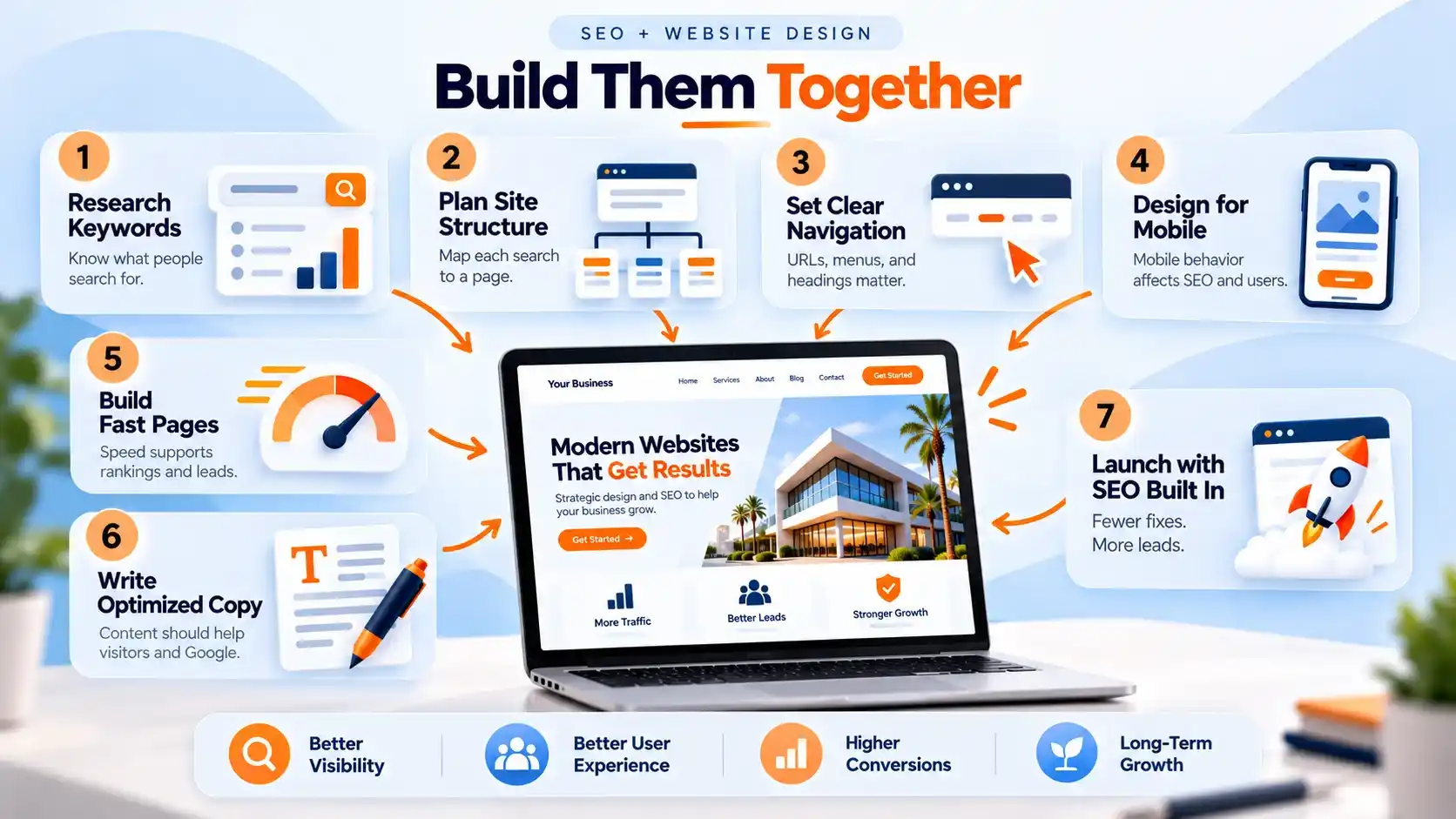
SEO and website design should be done together because the same choices control both. URLs, menus, headings, page layout, mobile behavior, speed, and copy decide how visitors use the site and how Google reads it.If SEO comes after design, you usually pay twice: once to build the site and again to fix it.
Yes, you need SEO when you hire a web design company. That does not mean a monthly campaign from day one. It means the technical and content basics are built in before launch. Ongoing SEO can be a separate decision.
How we handle this at Web Designer Orange County:We are a web design and SEO agency in Orange County. Before design starts, we research your competitors and keywords, map each search to a page, and plan the site structure around that. Then we design, write, and optimize every page before launch. The result is fewer fixes after launch and a site built to be found and to bring in leads.
Do I Need SEO When Hiring a Web Design Company?
Yes, at least the foundation. A site can look excellent and still bring in no customers if search engines cannot find, read, or understand its pages.
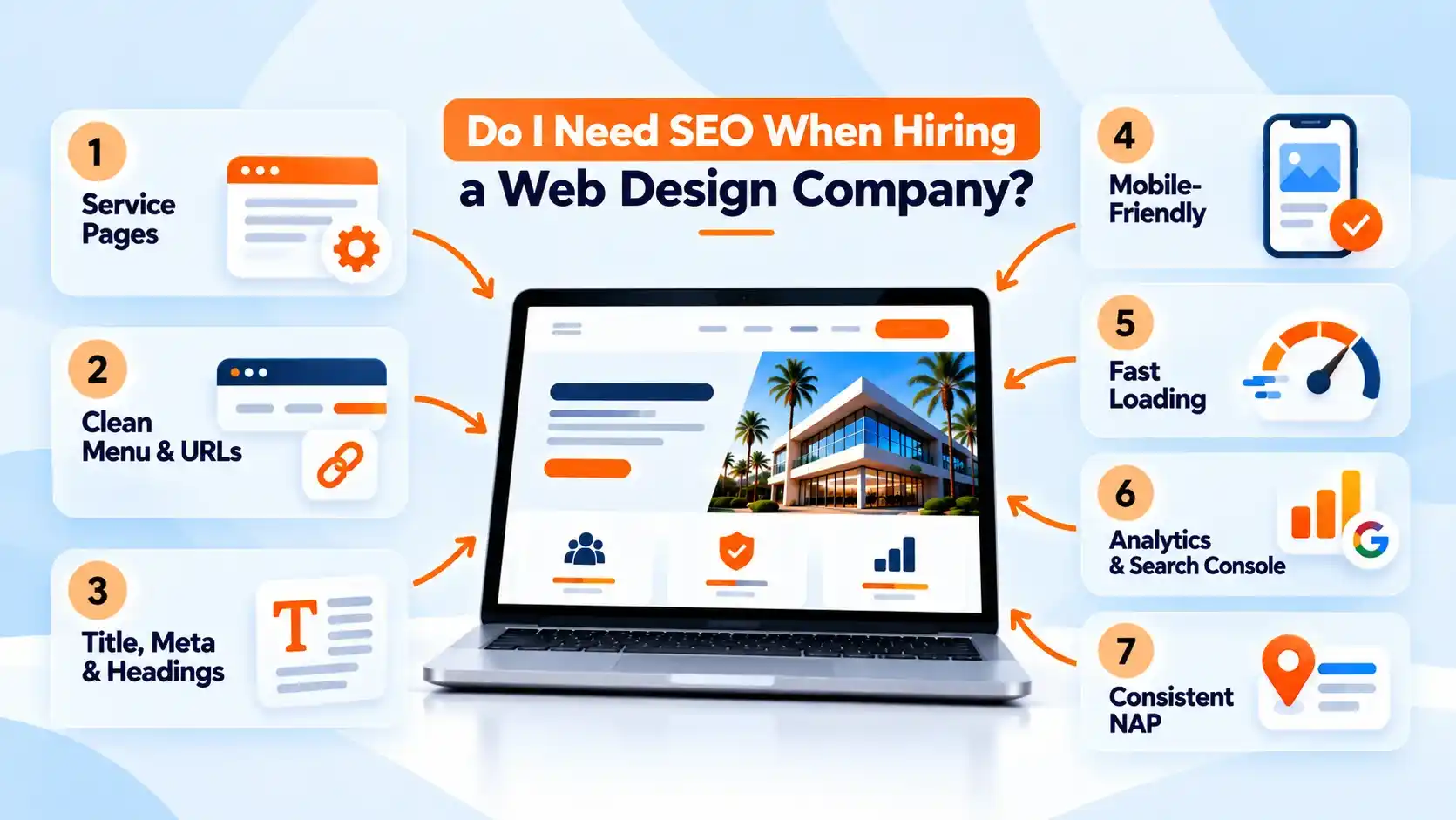
For a small business in Orange County, the foundation is:
- One page for each main service, matched to what customers search
- A clean menu and URL structure
- Unique title tags, meta descriptions, and headings on every page
- A mobile layout that shows the same key content as desktop
- Fast-loading pages
- Google Analytics 4 and Google Search Console set up before launch
- Consistent business name, address, and phone number
Blog content, link building, review campaigns, and monthly reporting are ongoing add-ons. The foundation is not, because building it in costs far less than retrofitting it.
How Does Web Design Affect SEO and Google Rankings?
Web design affects rankings through structure, speed, mobile layout, content, and code. Google does not rank a site for looking good. It reads what the design and development produce.
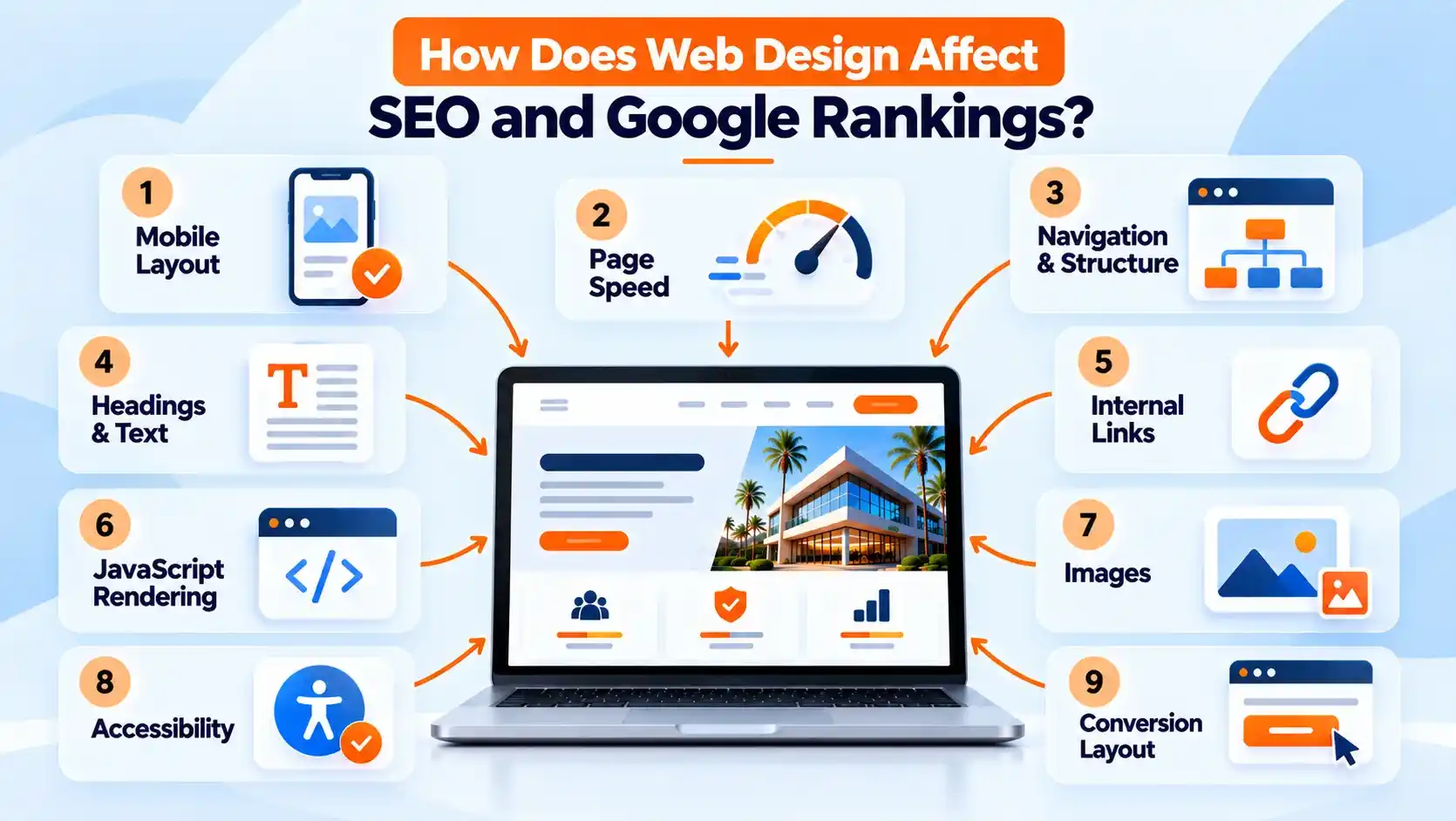
- Mobile layout. Google uses the mobile version of a site for indexing and ranking (Google Search Central, mobile-first indexing guidance). If your mobile design removes text or drops sections the desktop page has, that content may not count.
- Page speed and stability. Google’s Core Web Vitals measure how fast the main content loads (LCP), how quickly the page responds to a tap or click (INP), and whether the layout jumps around while loading (CLS). Oversized images, autoplay video, sliders, and heavy scripts hurt all three.
- Navigation and page hierarchy. The menu tells Google and visitors which pages matter. A service page buried three clicks deep looks less important than one linked from the main menu.
- Headings and text. A clear heading order (one H1, then H2 and H3 sections) helps readers scan and helps search engines understand the topic. Designs with very little text, or with text placed inside images, give Google little to read.
- Internal links. Google follows links it finds in the page’s code. Some card layouts, sliders, and JavaScript menus do not use standard links, so pages behind them can be hard to discover.
- JavaScript rendering. If the main copy only appears after scripts run, indexing can be delayed or incomplete.
- Images. Compressed images with descriptive file names and accurate alt text load faster and can appear in image search. Alt text also helps people using screen readers.
- Accessibility. Good color contrast, readable font sizes, labeled form fields, and keyboard-friendly navigation help all visitors and usually go along with cleaner code.
- Conversion layout. Rankings only matter if visitors act. Clear calls to action, a visible phone number, short forms, and trust signals like reviews and licenses decide whether traffic turns into calls and bookings.
Why Should SEO and Web Design Be Done Together Instead of Separately?
The expensive mistakes happen during design and development, often the one stage where no SEO specialist is present. After launch, fixes compete with bug reports and content edits.
| Decision made without SEO | What can happen | Later cost |
|---|---|---|
| URLs renamed for tidiness | Old pages lose rankings and links | Redirect mapping, recovery |
| One generic "Services" page | No page for each service or city | New pages and templates |
| Copy placed inside images | Google cannot read key text | Rebuilding sections |
| Sliders and heavy animation | Slow pages, layout shifts | Developer time |
| Mobile menu hides content | Content may be ignored | Template changes |
| Almost no text on pages | Thin pages, hard to rank | Rewriting and redesign |
| No tracking planned | No baseline to measure | Missing launch data |
| Staging site left on "noindex" | Live site does not get indexed | Lost weeks of visibility |
The last row happens more often than people expect. Development sites are usually blocked from search, and if that setting stays on at launch, the live site can stay invisible.
The reverse also fails. SEO planning without a designer can produce keyword-heavy, cramped pages that visitors leave. A page has two jobs: get found, then get the visitor to act.
Accountability is the other problem. When rankings drop after a redesign, separate companies can each point at the other. The designer says the redirects were missed. The SEO team says the wrong templates were built. The developer says the content came late. The business owner ends up refereeing. One accountable team turns that conversation into “what do we fix?”
What If SEO Comes First and Design Comes Second?
That has problems too. SEO planning without design input can produce pages packed with keywords, very long, and hard to read. Visitors leave quickly, or never call, because the page feels cramped or spammy.
A page has two jobs: get found, then get the visitor to act. SEO mostly serves the first. Design mostly serves the second. Planning both together means a page is structured for Google and easy to use on a phone.
Signs Your Website Was Built Without SEO
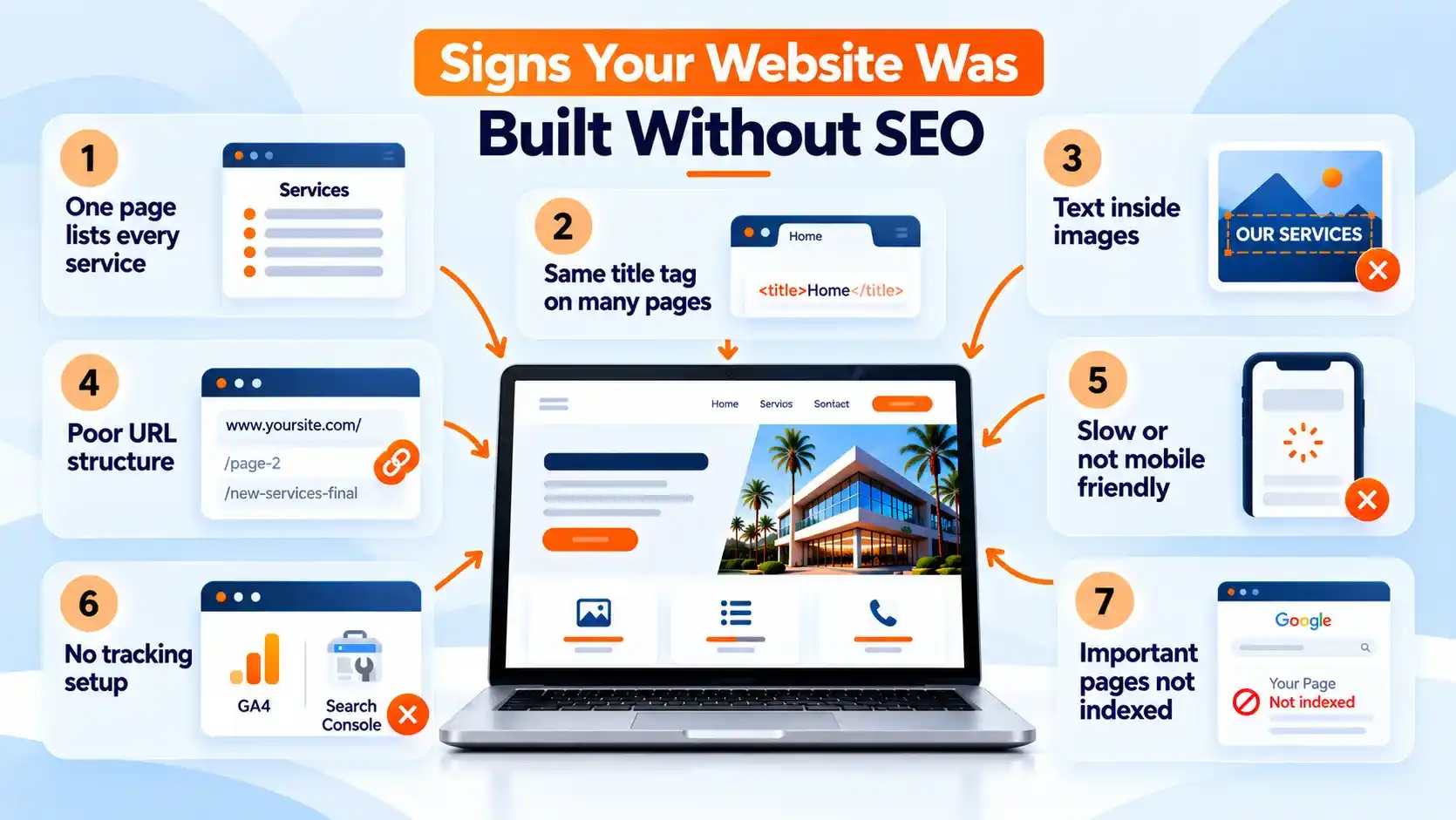
- One page lists every service
- Many pages share the same title tag, or titles say only “Home” or “Services”
- Pages have very little text, or key text sits inside images
- URLs look like /page-2 or /new-services-final
- The site is slow or awkward on a phone
- Search Console or GA4 was never set up
- Search Console shows important pages as not indexed
If several of these apply, an SEO audit before any redesign will show what to keep and what to rebuild.
What SEO Work Belongs in a Website Design Project?
Use this list, arranged by phase, to check any agency’s proposal.
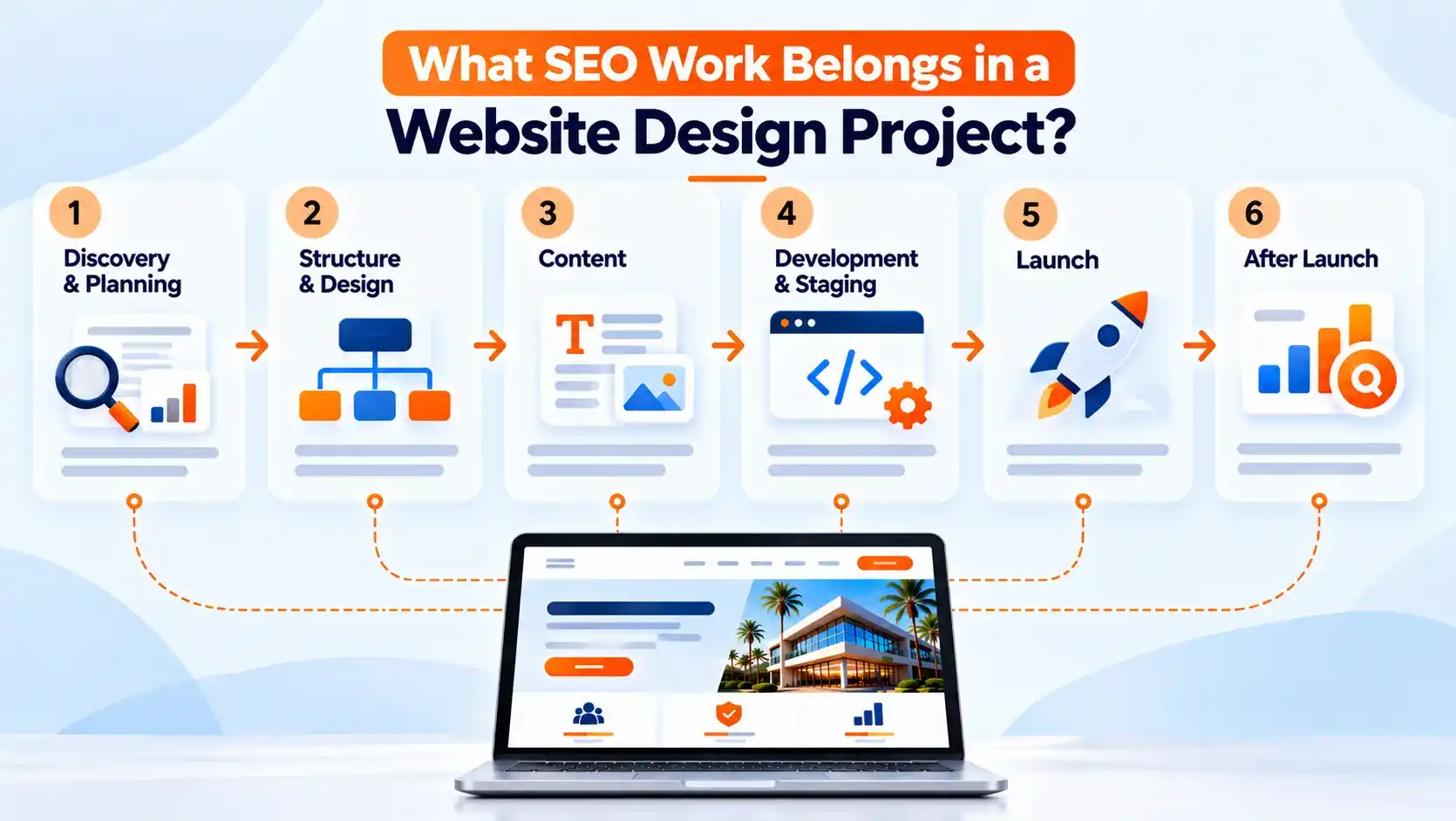
Discovery and planning
- Goals: calls, form fills, bookings, or sales
- Keyword research and page-to-keyword mapping (which page targets which search)
- Competitor and search result review
- Audit of the current site, including pages that already rank or earn links
Structure and design
- Site map, menu, and page hierarchy
- URL structure
- Wireframes with room for headings, copy, FAQs, reviews, and internal links
- Template rules for heading order, image sizes, and mobile behavior
Content
- Copy and headings for each priority page
- Title tags and meta descriptions
- Service pages, location pages (where justified), and FAQ content
- Image names and alt text
Development and staging
- Clean, semantic code
- Page speed and Core Web Vitals testing on staging
- Mobile content check against desktop
- Canonical tags, robots rules, XML sitemap
- JavaScript rendering check
- Structured data (schema markup, code that labels your business name, address, services, and reviews) matching what is visible on the page
- Forms, click-to-call buttons, and conversion tracking tested
Launch
- 301 redirect map for every old URL with value
- Remove any noindex or crawl blocks left from staging
- Submit the sitemap in Search Console
- Confirm GA4 and call tracking are recording
After launch
- Watch Search Console for crawl and indexing errors
- Check that redirects work and important pages do not return errors
- Compare rankings, traffic, and conversions to the baseline
- Fix template or content issues that show up in real data
Can a Web Design Agency Also Handle SEO for My Website?
Yes. At Web Designer Orange County, we handle both web design and SEO in one project. Many agencies can, but depth varies. Some offer real search strategy. Others install a plugin, fill in meta descriptions, and call it SEO.
One team means designers, developers, writers, and SEO specialists share one plan and one launch checklist, so problems get fixed faster. It does not mean equal skill in both areas, so ask the questions below, and feel free to ask us the same ones.
What Should I Look For in a Web Design Agency That Also Provides SEO?
Ask before you sign:
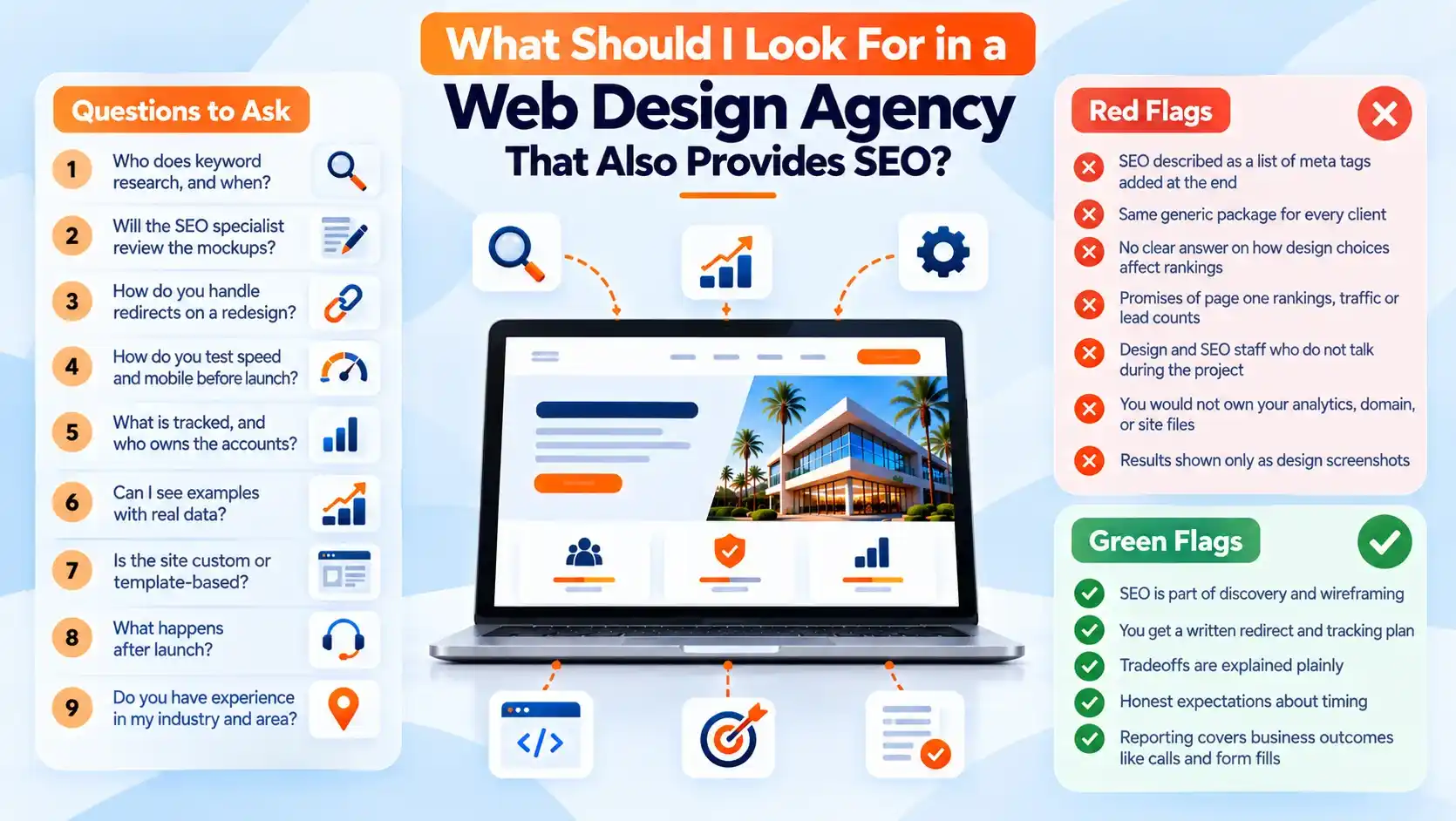
- Who does keyword research, and when? It should happen before wireframes, not after design approval.
- Will the SEO specialist review the mockups? If not, SEO is an afterthought.
- How do you handle redirects on a redesign? You should hear about a URL-by-URL map.
- How do you test speed and mobile before launch? Look for staging tests and Core Web Vitals.
- What is tracked, and who owns the accounts? You should own your Google Analytics, Search Console, domain, hosting login, and Google Business Profile.
- Can I see examples with real data? Ask for before and after numbers, not only screenshots.
- Is the site custom or template-based? Templates can work, but ask how they handle speed, headings, and structure.
- What happens after launch? Ask about monitoring, support period, and reporting.
- Do you have experience with businesses like mine, in my area? Local service SEO has its own tasks.
Red flags
- SEO described as a list of meta tags added at the end
- The same generic package offered to every client
- No clear answer on how design choices affect rankings
- Promises of page one rankings, traffic numbers, or lead counts
- Design and SEO staff who do not talk during the project
- You would not own your analytics, domain, or site files
- Results shown only as design screenshots
Green flags
- SEO is part of discovery and wireframing
- You get a written redirect and tracking plan
- Tradeoffs are explained plainly, such as a video header versus page speed
- Honest expectations about timing
- Reporting covers business outcomes like calls and form fills, not only rankings
Local SEO for Orange County Businesses
Local searches are usually tied to a city or neighborhood. People look for an HVAC website design company in Irvine, a dentist in Newport Beach, or a roofer in Santa Ana. A site that treats “Orange County” as one block can miss these searches.
Local planning in the design phase often includes:
- Separate service pages. One page per main service instead of one page listing everything.
- Location pages where they make sense. Build them for cities you truly serve, with specific content: neighborhoods, typical projects, real photos, and reviews. Copy-pasted pages with only the city name swapped are thin and can do more harm than good.
- Consistent business details. Use the same name, address, and phone number on your site and Google Business Profile.
- Google Business Profile link and map on the contact page.
- Local business schema that matches the visible details.
- Click-to-call on mobile. Many local searches happen on phones.
- Reviews and trust signals. Show reviews, licenses, service areas, and photos of real work.
- Service area honesty. If you have no storefront, follow Google Business Profile rules for service area businesses.
How Do I Redesign an Existing Site Without Losing Traffic?
Plan redirects and content before design starts, because the old site may hold years of links and rankings.
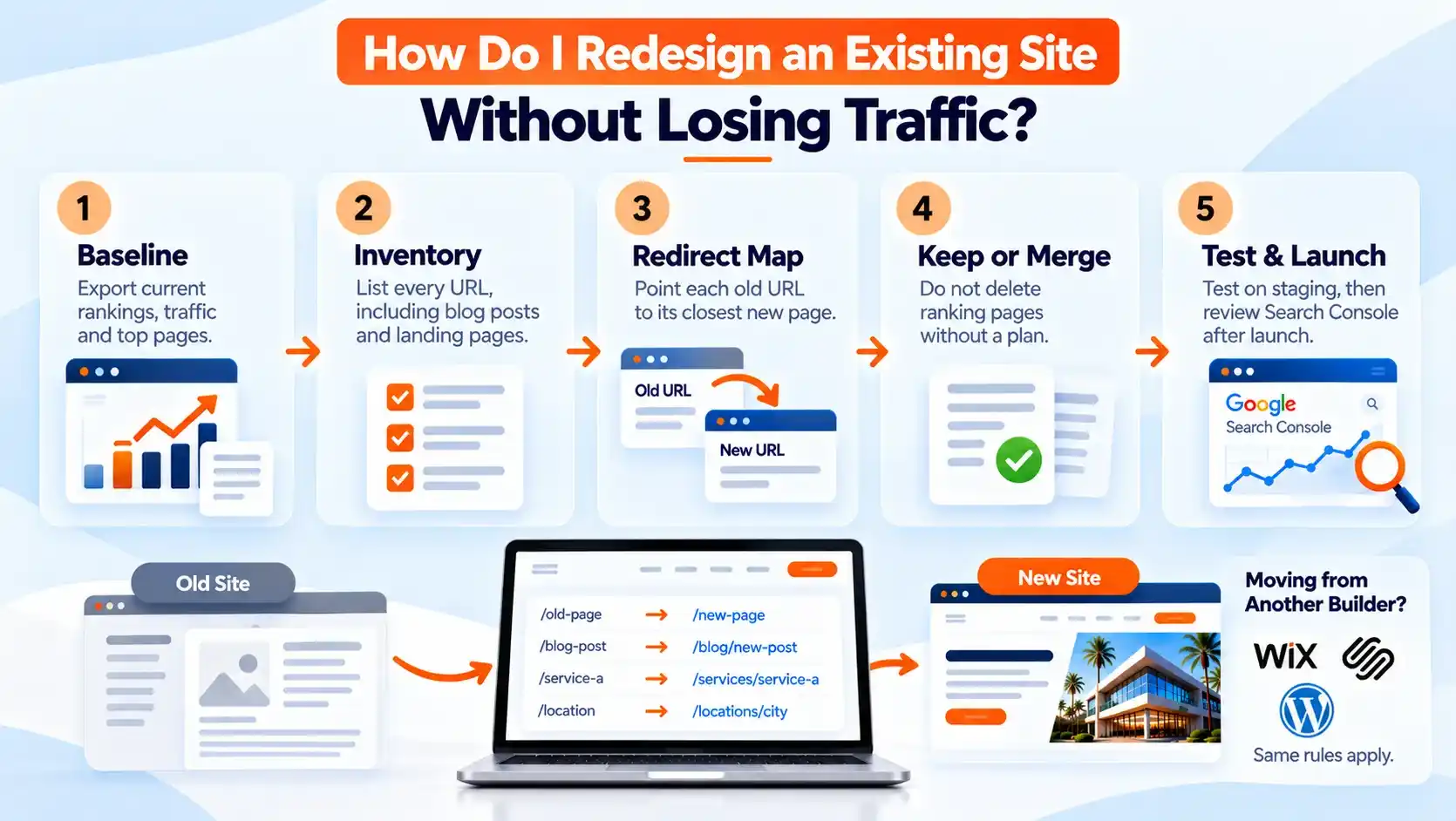
- Baseline. Export current rankings, traffic, top pages, and conversions.
- Inventory. List every URL, including old blog posts and landing pages.
- Redirect map. Point each old URL with value to its closest new page. Google’s site move guidance recommends mapping before redirects are configured.
- Keep or merge on purpose. eDo not delete ranking pages without a plan.
- Test on staging, then review Search Console after launch.
Moving from Wix, Squarespace, wordpress or another builder?
The same rules apply. Check that you can keep or redirect URLs, that headings and alt text carry over, and that the new platform gives you control over titles, schema, and speed.
A dip in traffic after a redesign is common, even when the work is done well. Good planning lowers the risk and shortens recovery. It cannot remove it.
How Much Does It Cost and How Long Does It Take?
Building SEO in usually costs less than adding it later, because you avoid rebuilding pages and reworking URLs. Price depends on page count, amount of new copy, and platform complexity.
An SEO-aware project takes longer than design alone because research, content, redirects, and testing are added. Timeline depends on page count, whether content is being rewritten, integrations such as booking or ecommerce, speed of feedback, and whether an older ranking site is being replaced. Be cautious of anyone promising a finished site with full SEO in a day or two.
When Can Separate SEO and Design Teams Still Work, and What Are the Limits?
They can work when ownership is clear: one person making final decisions, one launch checklist, one written redirect and tracking plan, and SEO access to staging before design is final. A phased launch can also fit a tight budget, though a rushed site without the basics often needs URL or template changes later.
Combining SEO and design does not guarantee rankings, traffic, or leads. Results depend on competition, industry, content, reviews, location, and site age. SEO often takes months to show clear results, and new sites can dip before they climb. What integration does is remove avoidable mistakes and give you clean data to work from.
Frequently Asked Questions
Usually yes, because one team owns the whole launch and nobody has to coordinate between two companies. At Web Designer Orange County, design and SEO are planned together from the start. Whoever you hire, choose based on proven skill in both areas, not only convenience.
Google does not issue a penalty for a slow site, but slow, unstable, or hard-to-use pages can rank lower and lose visitors. Page experience is one of many signals Google uses, and content relevance still matters most. A fast, clear site helps you keep the traffic you earn.
Usually not. Changing URLs, adding missing pages, rewriting copy, and fixing templates after launch often costs more than planning them at the start. Building SEO into the design phase means each page is done once instead of twice.
Because design choices such as URLs, menus, headings, page speed, and mobile layout also decide how Google reads your site. When both are planned together, you avoid rebuilding pages after launch and get a site that looks good and can be found.
Rankings can shift, especially if URLs, content, or page structure change. A redirect map, matching content, and testing before launch reduce the risk, but a short dip is common even when the work is done well. We plan these steps before design begins so recovery is faster.
Yes. Ads stop bringing traffic the moment the budget stops, while SEO builds visibility that continues. A well-structured, fast website also improves the landing page experience for your ads, so the same foundation supports both.
Web design affects rankings through how a site is built, not how it looks. Google indexes the mobile version of your pages, reads the code and text your design produces, follows the internal links it finds, and measures how fast and stable the pages load. Clear menus, clean URLs, real readable text, and fast mobile pages help Google understand your content. Heavy sliders, text inside images, or hidden mobile content can hold a good site back.
Longer than a cosmetic refresh, because keyword planning, content, redirects, and testing are included. The timeline depends on the number of pages, whether the content is being rewritten, and how quickly feedback and approvals come in. We give a clear timeline after reviewing your site and goals.
You need the foundation: page planning, site structure, title tags and headings, mobile and speed checks, and tracking. Ongoing SEO, such as blog content and link building, can be added later once the site is live.
Planning a new website or
redesign in Orange County?
We build the SEO plan first, then design every page around it. Tell us about
your site and we will show you what to build in before launch.